
SKIN CONCERN GUIDE · Skin Concerns
Closed Comedones vs. Pimples: What's the Actual Difference?
How to tell closed comedones apart from inflamed breakouts, why you shouldn't pop them, a cleansing-and-hydration checklist, and when to consider seeing a dermatologist.

Quick answer: Closed comedones typically start when a pore opening gets blocked by dead skin and oil. A closed comedone feels smooth with no inflammation, which is different from an inflamed pimple that's red, swollen, or shows a spot of yellow fluid. Some things that look like closed comedones aren't breakouts at all, and it can be hard to tell just by looking. If you can't tell on your own, consider seeing a dermatologist.
When small bumps spread across the forehead or cheeks, each one seems too small to worry about on its own — so they often get left alone. This guide lays out, for oily and combination skin in the teens through thirties, an order for telling these lesions apart by type, within the bounds of published literature. It doesn't diagnose exactly what a given bump is.
| Item | What's documented |
|---|---|
| Revive Therapy N.F Toner finished-product clinical study | 4-week, 12-application closed patch test · 25 enrolled · 21 completed |
| Revive Therapy N.F Toner formula | pH 5.5–6.5, mildly acidic |
| Revive Therapy N.F Toner size and price | 150 mL (5.07 fl oz) · $29.40 |
| Revive Therapy A.C Cleanser formulation | 0.5% salicylic acid |
| Revive Therapy A.C Cleanser size and price | 150 mL (5.07 fl oz) · $18.90 |
Where do closed comedones start?
The starting point for a closed comedone is the pore opening. When dead skin cells and oil block the opening of a hair follicle, a plug forms inside the widened follicle. When that plug stays closed beneath the skin's surface, it becomes a small white or skin-colored bump — a closed comedone, commonly called a whitehead. When the same kind of plug stays open at the surface instead, the trapped oil oxidizes and darkens, becoming an open comedone. We cover the open version in Nose oil and blackheads: sort them out before you squeeze.
The U.S. National Library of Medicine's StatPearls describes it this way: "closed comedones form when keratin and sebum block the follicular orifice beneath the skin surface, presenting as smooth, dome-shaped papules."
Inflamed breakouts follow a different path. When excess oil, bacteria, and dead skin get pushed further into the skin, redness and swelling follow, forming a small red bump — and if yellow fluid collects, it becomes a pustule. A comedone that's been present for a while can also progress into a red bump or pustule as bacteria multiply around it and inflammatory cells gather. The overlap between dead skin and oil is covered further in Why pores look larger — looking at oil and elasticity together.
How do you tell them apart?
Start by noting color and surface texture.
| Type | What you see | What else to check |
|---|---|---|
| Closed comedone (whitehead) | A small, smooth, white or skin-colored bump | No visible follicle opening |
| Open comedone (blackhead) | A bump with a dark center | That's the color of trapped, oxidized oil |
| Inflamed papule or pustule | Red and swollen, or shows yellow fluid | Comes with redness and swelling |
| When it's hard to tell what a small bump is | You can feel it, but it doesn't clearly match any of the above | Some lesions aren't breakouts at all |
Milia form as benign keratin cysts beneath the epidermis rather than in a follicle, so they arise through an entirely different process from comedones. Even so, literature on milia lists comedonal acne as part of the differential diagnosis. This table is meant to guide what to observe — it isn't a tool for making a final call.
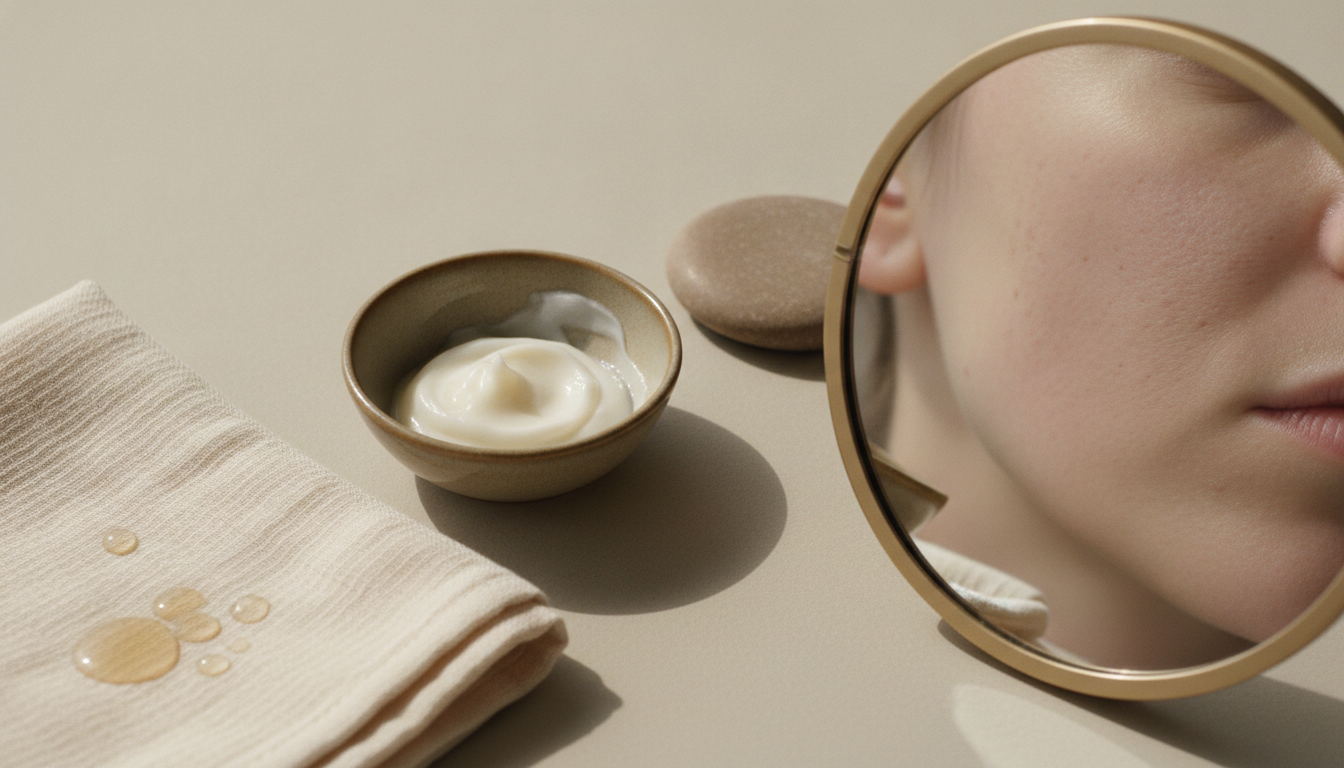
Sorting by color and surface texture before touching anything gives you a starting point.
Three things to check right now
1. Note how hard and how often you're cleansing
Without rubbing the affected area, start by writing down how many times a day you cleanse and how. Cleansing guidance is covered in Mildly alkaline foam cleansers — is daily use okay? A cleansing guide for breakout-prone skin.
2. Check whether you've skipped the hydration step
Check whether you've been skipping moisturizer because your skin looks shiny. A morning-and-night order is covered in Skincare order for breakout-prone skin: how morning and night differ.
3. Retrace anything you've added recently
Write down, one line each, any product you've started using in the last month or two, any sunscreen switch, and anything that touches your face often. Changing several things at once makes it impossible to tell what actually overlapped with the change in your skin.

Writing down each change one line at a time gives you something to compare.
Is it okay to squeeze what looks like a closed comedone?
Pressing with your fingers pushes the contents further into the skin and makes inflammation worse. Squeezing, picking, and scratching all raise the risk of scarring.
The American Academy of Dermatology (AAD) advises: "popping, squeezing, or picking at acne can increase your risk of getting acne scars."
How to choose SKIN9HARI products for this concern
If you're weighing whether to buy another product for spots that look like closed comedones, compare products by what's actually documented about each rather than by efficacy claims. SKIN9HARI's Revive Therapy N.F Toner received the result "assessed as having low comedogenic potential (non-comedogenic) and suitable for use on acne-prone skin" in a finished-product clinical study conducted by Elead Co., Ltd., based on a 4-week, 12-application closed patch test on the upper back. SKIN9HARI's Revive Therapy A.C Cleanser is a rinse-off formula containing 0.5% salicylic acid; this is a disclosure of formulated concentration only, not confirmation that the finished product has a proven effect. Results may not be the same for every skin type.
| Product | What's documented | Why it fits this concern |
|---|---|---|
| Revive Therapy N.F Toner · 150 mL (5.07 fl oz) · $29.40 | pH 5.5–6.5, mildly acidic. Finished-product clinical study result confirmed | When you want a tested result at the leave-on step |
| Revive Therapy A.C Cleanser · 150 mL (5.07 fl oz) · $18.90 | Formulated with 0.5% salicylic acid. Mildly alkaline formula | When you want a disclosed concentration in a rinse-off step |
Clinical study evaluating comedogenic potential — result: "assessed as suitable for use on acne-prone skin" | Testing institution: Elead Co., Ltd. | Report No.: EL-180125057I007 | Test period: February 19 – April 13, 2018 | 4-week, 12-application closed patch test | Subjects: 25 enrolled, 21 completed (average age 29.24) | Individual results may vary
When should you see a dermatologist instead of buying more products?
Consider a dermatologist visit rather than another product if you notice any of the following:
- A spot that was smooth turns red, swollen, or starts filling with fluid.
- Pressing on it to push the contents out has made the swelling worse.
- You've already picked, squeezed, or scratched the area.
- You can't tell on your own whether what looks like a closed comedone is actually a breakout.

Opening a booking screen instead of reaching for the spot with your hands.
Related guides
- Teen breakouts: when to see a doctor — a guide to cleansing, hydration, and habits
- If your skin looks shiny but feels tight — why oily skin needs hydration too
- If your skin is dry but keeps breaking out — a checklist for cleansing and hydration
FAQ
My forehead is covered in tiny bumps — are these breakouts?
If it's a closed comedone caused by a pore opening blocked by dead skin and oil, that counts as a non-inflamed form of acne. That said, some things that look like closed comedones aren't breakouts at all, and it's hard to tell just by looking.
What's the actual difference between a closed comedone and a regular pimple?
Redness and swelling are the dividing line. A closed comedone feels smooth with no inflammation, while an inflamed papule or pustule is red and swollen, or shows yellow fluid.
Is it okay to squeeze a closed comedone?
Pushing the contents inward increases inflammation, and squeezed or picked spots carry a higher scarring risk. It's better not to press on it with your hands.
If dead skin causes closed comedones, is that all I need to address?
Dead skin and oil work together to form the plug, so it's hard to address just one side. Track how you're cleansing and your hydration step together and compare.
If a spot that looks like a closed comedone turns red, should I see a doctor?
A comedone that's been present for a while can develop surrounding bacterial growth and inflammatory cells, becoming a red bump or pustule. If a smooth spot changes like that, consider seeing a dermatologist.
In one sentence
Closed comedones start with a blocked pore opening, so sort by redness and swelling first, track your cleansing, hydration, and anything you've recently added without squeezing anything, and consider seeing a dermatologist if you notice redness, swelling, or fluid.
Sources
- American Academy of Dermatology (AAD). Types of acne breakouts.
- Sutaria AH, et al. Acne Vulgaris. StatPearls, 2023.
- Najeeb S, Gaurav V, Sharma S. Comedones in dermatology. Indian Journal of Dermatology, Venereology and Leprology, 2024.
- Gallardo Avila PP, Mendez MD. Milia. StatPearls, 2023.
- American Academy of Dermatology (AAD). Pimple popping: Why only a dermatologist should do it.
- American Academy of Dermatology (AAD). Acne scars: Who gets and causes.
This guide is general skincare information, not medical advice. SKIN9HARI products are cosmetics and are not intended to diagnose, treat, cure, or prevent any disease. If a skin problem is painful, spreading, or persistent, see a dermatologist.